The Most Spoken Languages in the World: Total vs Native Speakers
English has the most speakers in total, but Mandarin has more than twice as many native speakers. Here are both rankings from one source, Ethnologue 2026, and the counting choices behind them.
"Most spoken" can mean two different things. Counted by total speakers, native plus second-language, English is first. Counted by native speakers only, Mandarin Chinese leads by more than double. This article uses the total-speaker ranking for the main top 10 and shows the native ranking next to it. Every figure comes from one source: Ethnologue 2026, the annual top-200 list published by SIL's Ethnologue and tabulated on Wikipedia in March 2026. Numbers are in millions.
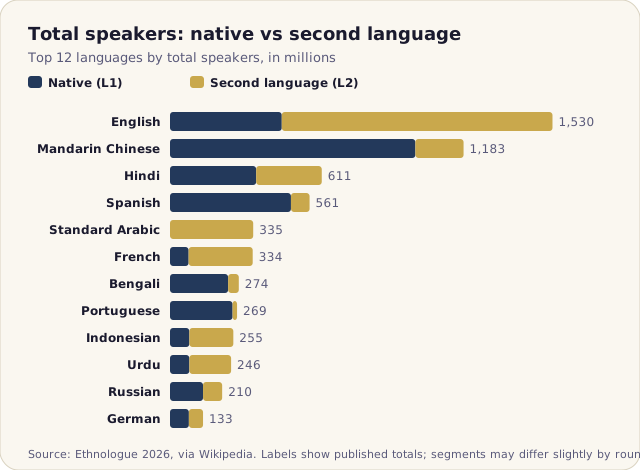
The top 10 by total speakers
Linguists call a first language L1 and any language learned later L2. Ethnologue publishes both for each language, and the total is what most "most spoken" lists rank.
| Rank | Language | Native (L1) | Second language (L2) | Total | Branch |
|---|---|---|---|---|---|
| 1 | English | 450 | 1,090 | 1,530 | Germanic |
| 2 | Mandarin Chinese | 988 | 194 | 1,183 | Sinitic |
| 3 | Hindi | 347 | 264 | 611 | Indo-Aryan |
| 4 | Spanish | 487 | 75 | 561 | Romance |
| 5 | Standard Arabic | 0 | 335 | 335 | Semitic |
| 6 | French | 75 | 258 | 334 | Romance |
| 7 | Bengali | 234 | 43 | 274 | Indo-Aryan |
| 8 | Portuguese | 252 | 18 | 269 | Romance |
| 9 | Indonesian | 78 | 177 | 255 | Austronesian |
| 10 | Urdu | 78 | 168 | 246 | Indo-Aryan |
| 11 | Russian | 133 | 77 | 210 | Slavic |
| 12 | German | 76 | 57 | 133 | Germanic |
Millions of speakers, Ethnologue 2026. Ethnologue rounds each column separately, so L1 + L2 can differ from the total by a few million. Nine of the twelve are Indo-European. Mandarin is Sino-Tibetan, Standard Arabic is Afro-Asiatic and Indonesian is Austronesian.
Three points in this table correct common lists, including the earlier version of this page:
- Indonesian is in the top 10, Russian is not. Indonesian has 255 million speakers and sits 9th. Russian has 210 million and is 11th, 45 million behind. Older lists that put Russian at about 255 million overstated it by about 21%.
- Standard Arabic is 5th and French 6th, separated by just one million speakers (335 vs 334 million). They are not tied.
- Mandarin is now 1,183 million, not "about 1.1 billion", and Urdu has 246 million, not 230 million.
The top 10 by native speakers
Rank by first language only and the order changes a lot. Languages that are mostly learned at school or at work drop out, and languages spoken almost entirely at home move up.
| Rank | Language | Native speakers | Rank by total |
|---|---|---|---|
| 1 | Mandarin Chinese | 988 | 2 |
| 2 | Spanish | 487 | 4 |
| 3 | English | 450 | 1 |
| 4 | Hindi | 347 | 3 |
| 5 | Portuguese | 252 | 8 |
| 6 | Bengali | 234 | 7 |
| 7 | Russian | 133 | 11 |
| 8 | Japanese | 124 | 13 |
| 9 | Western Punjabi | 90 | 22 |
| 10 (tie) | Vietnamese, Turkish | 86 | 17, 21 |
Millions, Ethnologue 2026. Western Punjabi's figure is from Wikipedia's native-speaker list, because the total table does not split it.
Spanish is the clearest winner of this switch: it is 2nd by native speakers but 4th by total, because only 75 million people speak it as a second language. Japanese is the extreme case, with 124 million native speakers and only about 2 million L2 speakers. English's native figure is the least settled number here. The 2026 total table gives 450 million, while Wikipedia's native-speaker list, also drawn from Ethnologue, gives 372 million. With either figure English is 3rd.
Why the two rankings disagree
The gap comes from how a language is used. Some languages spread through schools, government, trade and the internet. Others are mostly passed from parents to children.
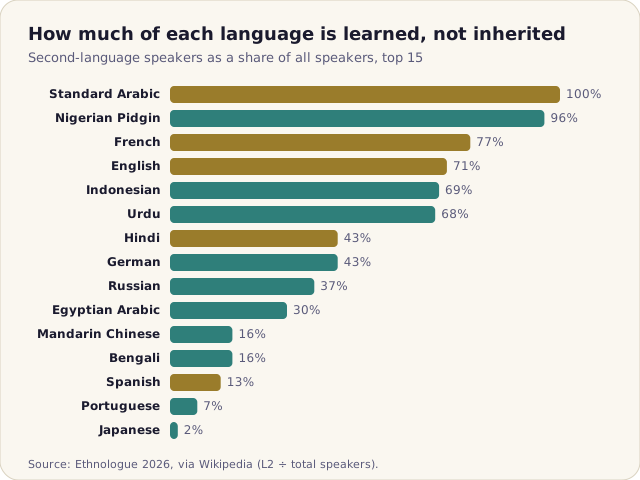
Mostly learned: English, French, Indonesian
About 71% of English speakers learned it as a second language: 1,090 million out of 1,530 million. French is even more tilted, with 258 million L2 speakers against 75 million native speakers, a ratio of about 3.4 to 1. Much of that growth is in Africa. Wikipedia's French article describes it as the fastest-growing language on the continent "in terms of either official or foreign languages", and the International Organisation of La Francophonie estimated 348 to 396 million French speakers in 2025, depending on the method. Ethnologue's 334 million is lower because the two count fluency differently.
Indonesian follows the same pattern inside one country. Indonesia has about 281 million people (UN estimate for 1 July 2023), but only 78 million speak Indonesian as a first language. Most grow up with Javanese, Sundanese or another regional language and learn Indonesian at school, which is how it reaches 255 million speakers in total.
Two African languages show the same thing at an even larger scale. Nigerian Pidgin has about 5 million native speakers and 116 million L2 speakers across Nigeria, and Swahili has about 4 million native speakers and 91 million L2 speakers in East Africa.
Mostly native: Spanish, Portuguese, Japanese, Bengali
Spanish is official in 20 sovereign states, plus Puerto Rico, and nearly all of its 561 million speakers grew up with it: 87% are native speakers. Portuguese (over 90% native) is concentrated in Brazil, and Bengali (about 85% native) in Bangladesh and the Indian state of West Bengal. These languages rank higher by native speakers than by total.
Ethnologue lists Modern Standard Arabic with 0 native speakers and 335 million second-language speakers. Children across the Arab world grow up speaking a local variety, such as Egyptian, Gulf or Maghrebi Arabic, and learn the standard language at school for reading, writing, news and formal speech. Egyptian Arabic alone has 83 million native speakers and ranks 15th by total, with 118 million.
Counting choices that change the ranking
A ranking depends on where you draw the line between "a language" and "a dialect". Ethnologue splits some languages that many people treat as one, and every list built on its data inherits those choices.
Hindi and Urdu
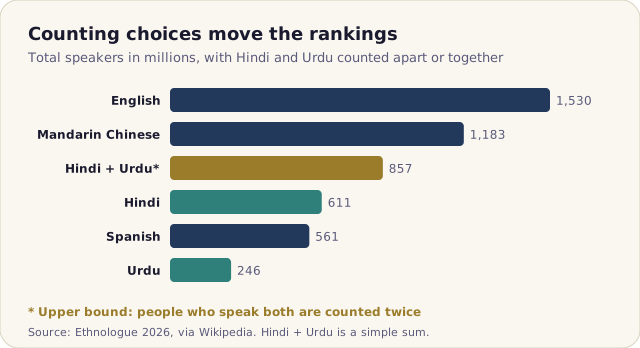
In everyday speech, Hindi and Urdu are largely mutually intelligible. They are written in different scripts (Devanagari and Perso-Arabic) and borrow formal vocabulary from different sources (Sanskrit, and Persian and Arabic). Linguists sometimes call the shared spoken language Hindustani. Ethnologue counts Hindi and Urdu separately, which is why Hindi is 3rd and Urdu 10th.
Worked example: what if Hindustani were counted as one language?
Hindi has 611 million speakers and Urdu 246 million. Added together, that is 857 million. This would still be 3rd, but 296 million ahead of Spanish instead of 50 million ahead of it, and 326 million behind Mandarin.
857 million is an upper bound, because many people in India and Pakistan speak both and would be counted twice. The native figures do not have this problem, since each person has one first language: 347 + 78 = 425 million native speakers of Hindustani, still 3rd behind Mandarin and Spanish.
The same overlap is why you cannot add up the whole table. The top 10 total 5,598 million speakers, but that does not mean 5.6 billion different people. Many of them are counted under two or three languages. For example, a Pakistani who speaks Punjabi at home and Urdu and English at school appears in three rows.
Chinese or Mandarin
"Chinese" is a family of varieties that share a writing system but are often not mutually intelligible when spoken. Ethnologue treats Chinese as a macrolanguage and ranks the varieties separately: Mandarin (988 million native speakers), Yue, which includes Cantonese (85 million), Wu, which includes Shanghainese (83 million), and others. A list that ranks "Chinese" as one language puts it well ahead of everything else by native speakers. A list that ranks only Mandarin still puts it first. Mandarin is the official or national standard language of China and Taiwan, and one of Singapore's four official languages.
Arabic
Arabic works the same way. Treat it as one macrolanguage and its native speakers are all the speakers of its spoken varieties added together. Treat Modern Standard Arabic on its own, as Ethnologue's top-200 list does, and it has 0 native speakers but still ranks 5th by total.
Spread is not the same as size
A large number of speakers does not mean a language is used in many countries. English has the widest official spread: Beelad's country pages list English among the official or main languages of 58 of the 196 countries covered (see official languages by country). French is an official language in 26 countries as of October 2026. Mali removed it as an official language in 2023, Burkina Faso in 2024 and Niger in 2025; Mali and Niger now call it a working language. Bengali, with 274 million speakers, is official at national level only in Bangladesh, plus Indian states.
The UN's six official languages (Arabic, Chinese, English, French, Russian and Spanish) were fixed between 1946 and 1973, when Arabic was added. They reflect the politics of that period, not today's speaker numbers. Hindi, Bengali, Portuguese and Indonesian are all larger than Russian by total speakers but are not UN official languages.
How reliable are these numbers?
Ethnologue's 27th edition (2024) counted 7,164 living languages, and it updates its estimates every year. The top-language figures combine censuses, surveys and estimates of differing age and quality, and second-language fluency is hard to measure. Treat them as good to the nearest few tens of millions, not to the last million. Census data is a different source again; see our guide to population and census data.
- Compare languages within one edition of one source. Mixing Ethnologue 2026 with a 2019 list is how Russian ended up in older top-10 lists.
- Check whether a list ranks total or native speakers before comparing it with another.
- Check how it treats Chinese, Arabic and Hindi–Urdu, since these choices move several places at once.
Key takeaways
- By total speakers (Ethnologue 2026): English, Mandarin, Hindi, Spanish, Standard Arabic, French, Bengali, Portuguese, Indonesian, Urdu.
- By native speakers: Mandarin leads with 988 million, then Spanish, English, Hindi and Portuguese.
- Russian is 11th by total but 7th by native speakers. Indonesian is the reverse.
- Standard Arabic has no native speakers, and combining Hindi and Urdu or the Chinese varieties changes the gaps but not the top three.
Frequently asked questions
What is the most spoken language in the world?
By total speakers, English, with about 1,530 million (450 million native and 1,090 million second-language speakers, Ethnologue 2026). By native speakers, Mandarin Chinese leads with about 988 million.
Is Russian one of the 10 most spoken languages?
Not by total speakers. Ethnologue 2026 puts Russian 11th with about 210 million speakers, behind Indonesian (255 million) and Urdu (246 million). By native speakers, Russian is 7th with about 133 million.
Why does Standard Arabic have zero native speakers?
People across the Arab world grow up speaking a local variety such as Egyptian or Gulf Arabic and learn Modern Standard Arabic at school. Ethnologue therefore lists Standard Arabic with 0 native and about 335 million second-language speakers.
How many languages are there in the world?
Ethnologue's 27th edition (2024) counted 7,164 living languages. The count changes slightly each year as languages are reclassified or lose their last speakers.
Sources
- List of languages by total number of speakers (Ethnologue 2026 table), Wikipedia
- List of languages by number of native speakers, Wikipedia
- Welcome to the 27th edition, Ethnologue (SIL International)
- French language, Wikipedia
- Spanish language, Wikipedia
- Official languages of the United Nations, Wikipedia
See each country's languages
Every Beelad country page lists its official and main languages next to population, capital and currency. Search by name or capital.
Search countries →